
Leading Up: Enhancing your Board Partnership
Four ways nonprofit executive directors and CEOs build a high performing board relationship — shared context, challenges raised early, solutions with a recommendation, and real structure — from an Oregon attorney who has supervised an executive from the board seat and reported to a board as a leader.
Nobody hands a new executive director a guide to managing the board relationship.
You're hired to run the organization, and then you discover the other half of the role: a room of volunteers who are, collectively, your supervisor. They meet monthly. They have full lives and other careers. And the partnership you build with them will shape almost everything you're able to accomplish.
I've sat on the board side of that relationship. As a board member, I supervised and reviewed an executive. As a senior leader, I reported to a board myself. Across years of leading and serving youth soccer organizations across the Northwest, I've seen the partnership from both chairs. The strongest ones were never accidents. They were built, with purpose, mostly by executives who understood what the board side actually needed.
Here are the four practices that kept proving out, along with what the board seat is really thinking on each one.
Report consistently to build shared context
The first practice is a rhythm: a short, consistent report at every meeting covering finances, people, programs, and what's coming next. The board will never know the day to day the way you do, and it shouldn't need to. What it needs is a shared starting point for every decision — context that fits the governing role.
Here's what that rhythm buys you. When the board already knows the landscape, a big decision takes one meeting instead of three. There's no catching anyone up, no re-litigating background, no deferring to next month for more information. The reporting rhythm you set in calm months is the decision speed you get in hard ones. Building board reporting and governance rhythms is part of our core work → Services.
Raise challenges right away
That steady rhythm is also what makes the second practice work. Boards do their best work with time and context. The executives I worked with who brought challenges forward immediately gave the board room to actually help: to open doors, adjust expectations, ask better questions, and stand behind the response when it came. An issue that arrives late arrives as a decision already made, and a board asked only to ratify is a board that starts wondering what else it hasn't heard.
From the board seat, a challenge raised early reads as leadership, not weakness. An executive who says "here's what's developing, and here's what I'm doing about it" builds exactly the trust that expands their room to lead. The relationship you want in a hard moment is built in all the ordinary ones before it.
Bring solutions, not just issues
A useful boundary first: executives decide almost everything. The board's decisions are governance, plus specific defined matters. When something truly belongs on the board table, the strongest executives I've worked with frame the solution: here's the issue, here are two or three realistic paths, and here's my recommendation. The board still decides — that's its role, and a good executive protects it. But framing the solution is leading; deciding is governance. When both halves are done well, the whole organization moves faster.
There's a career dimension to this one too. An executive who consistently brings framed decisions with a sound recommendation is building a track record the board can see, meeting after meeting. That's the record that earns latitude, and it's the record a documented review can actually reward.
Ask for the structure performance relies on
This is the practice executives skip most, and it's the one I'd put first.
Documented goals for your role. A real, documented annual review. A clear line between what's yours to run and what's the board's to decide. Your performance, and the organization's, is built on that structure. Most boards want to provide it; many volunteer directors were simply never provided it themselves, in this seat or any other. Someone has to start the conversation, and the executive asking for structure isn't criticizing the board. That request is leading up at its best.
I've written an executive's review from the board side, and I can tell you what documented goals and a regular review give both parties: shared, objective footing. Your accomplishments become visible instead of assumed. Hard conversations become professional instead of personal. And the one person the mission depends on most gets what every high performing leader needs — a clear picture of what success looks like and an honest account of progress toward it.
Build the partnership with purpose
Four practices: consistent reporting that builds shared context, challenges raised early, solutions with a recommendation, and a request for real structure. None of them require a bigger budget or a different board. All of them are teachable, and every one compounds. The executives who build this partnership don't just have smoother meetings; they lead organizations that decide faster, retain their leaders, and hold the trust of members, donors, and their communities.
The reasonable cost of putting these basics in place is small next to what they make possible.
About Advance Law NW
I'm Robin Bostwick. Before opening Advance Law NW, I led and worked with mission-driven organizations, reported to their boards, and supervised and reviewed an executive from the board seat. Advance Law NW is an Oregon practice offering accessible, year-round counsel to nonprofits and small businesses: bylaws drafting and review, board and leadership structure, executive reviews and employment support, and board member training.
If you're an executive director, CEO, or board member building this partnership at your organization, that's exactly the work I do. Tell us about your organization → Contact.
This article is general information, not legal advice. Reading it does not create an attorney–client relationship.
The Board Year
A simple quarter-by-quarter calendar for nonprofit boards: when to onboard new directors, review bylaws and confirm committees, align policies, run a leadership review, check contracts, and hold elections. Built for Oregon board members and executive directors who'd rather handle the basics on a rhythm than in a scramble.
Most board work doesn't pile up because someone dropped the ball. It piles up because nobody put it on a calendar.
I've reported to boards as a staff member and served on them as a director, across years of leading and serving youth soccer organizations across the Northwest. The strongest boards I worked with had something in common, and it wasn't talent or budget. They avoided reactive governance. They ran on a rhythm: a handful of governance responsibilities they executed every year, at roughly the same time, so the work stayed current on its own.
That rhythm is learnable, and it fits on a single page. Here's what a high performing board year looks like, quarter by quarter, and what belongs in each one. Adjust the timing to your own fiscal year. The sequence is what matters, not the exact month.
Q1: Start with onboarding
Begin the year with the people who just joined it. A new director who's given the bylaws, recent financials, a role description, and a real orientation can contribute by month two. A director who's told "you'll pick it up" gives the organization a year of quiet first, and good people don't stay quiet for long before they drift away.
Onboarding is also where the board sets what protects it: a signed conflict of interest policy and a clear understanding of confidentiality. Getting those on the table early gives every new director a confident footing and the board a clean record. Onboard right after the seats are filled, while the energy is fresh, and goodwill becomes governance. It's also how you build your volunteer pipeline. People give their time to boards that clearly value it, and they tell other good people. Board training and member onboarding is one of our core services.
Q1: Strengthen the foundation
With the new board seated, turn to the document you actually govern by. Read the bylaws as a board, out loud if you have to, and update what no longer matches how you operate. This is also the moment to confirm your committees for the year, so the work has somewhere to live and someone to own it.
Practice drifts from the bylaws a little every year. A meeting cadence changes, a committee quietly stops meeting, an election gets handled differently than the document describes. It rarely happens through carelessness. It happens because volunteers are busy and institutional memory turns over. The calm start of the year is the natural moment to bring your bylaws and your practice back into line, so the rules you govern by describe the organization you actually run. Bylaws review and updating is one of our core services.
Q2: Align policy with process
Once the bylaws are current, work down a level to the policies that sit beneath them: conflict of interest, financial controls, document retention, decision matrices, a board code of conduct.
These are the rules that let your leadership run the day to day with confidence and let the board point to a clear standard when it needs one. An annual pass keeps policies consistent with how the organization actually runs, instead of describing a version of the organization that existed three executive directors ago. It's a short agenda item that makes every harder conversation easier, because the standard is already written down and already agreed to.
Q3: Empower leadership
Most nonprofit boards have exactly one key person to support and hold accountable: the executive director. That relationship thrives on clear expectations.
Empower your leader with a documented review built on goals you set together. A good review gives your leader objective footing, a shared picture of what success looks like, and a forum to lead up and raise what they need to succeed. Talent thrives with clear feedback. Directors owe the organization a duty of care under Oregon law — acting in good faith and in the organization's best interest, means supporting leadership with honest, documented feedback. The effort and time it takes to provide meaningful feedback protects the organizatio and supports the person your mission depends on most.
Q3: Ensure compliance
Once a year, pull the agreements the organization runs on and confirm they are up to date: leases, vendor and service contracts, insurance, the executive director's employment agreement, and your annual state and federal filings.
Knowing what you've signed, what it commits you to, and when it renews keeps the board ahead of its obligations instead of reacting to a renewal notice that arrives the week it's due. This is also a good moment to confirm your registrations and reports are current. A board that knows its obligations makes faster, more confident decisions, because it isn't reacting to tight deadlines.
Q4: Renew the board
Elections are where the board renews itself, and they're worth running with care. Run them according to your bylaws: proper notice, a quorum, a slate and nominations, and a recorded vote.
Done on schedule and on the record, every seat is filled with clear legitimacy, and the decisions the new board makes hold up under scrutiny from members, funders, and future boards. Tie the election to your annual meeting, and the cycle closes cleanly: the directors seated in Q4 are the ones you onboard at the start of the next year, which is exactly where this calendar began. Current rules, applied cleanly, producing a board everyone can stand behind.
The rhythm is the point
Here is the board year: onboarding plus a bylaws and committee review to open it, policies aligned in Q2, leadership review and contract checks through Q3, and elections at the annual meeting to close it and start the cycle again. All of this is manageable and affordable.
The reason to map it to a calendar is simple. Volunteer boards and stretched executive directors don't lose track of the basics because they don't care. They lose track because there's a mission to run and no obvious moment to focus on governance. A calendar creates the moments. Build the rhythm once, and the basics stay current on their own, which is exactly what high performing organizations have in place behind the scenes. Trust from members, donors, and communities, leaders who stay, volunteers who want to serve, and a mission that outlasts any one person all grow out of the annual rhythm.
About Advance Law NW
I'm Robin Bostwick. Before opening Advance Law NW, I led and worked with mission-driven organizations, and served on and reported to their boards, through every step in this calendar and a few more. Advance Law NW is an Oregon practice offering accessible, year-round counsel to nonprofits and small businesses: bylaws drafting and review, policies and procedures, board training and onboarding, employment support, elections, and contracts, handled on a rhythm rather than in a rush.
If you're a board member or an executive director who'd like a board year that fits your organization, that's exactly the work I do. Tell us about your organization.
This article is general information, not legal advice. Reading it does not create an attorney–client relationship.
Same Budget, Two Boards
Two nonprofits, same mission and same budget. One built the governance basics in early; one meant to. A year later they look nothing alike. A plain look at what clear roles, current bylaws, documented reviews, and real onboarding actually buy. For Oregon board members and executive directors.
Picture two organizations. Same mission, same budget, the same good and committed people giving their evenings to a cause they believe in. There is one difference between them, and it is easy to miss. One board built a few governance basics in early, while things were calm. The other meant to, and then the year got busy the way every year does.
I've worked with both kinds of board, so I'll call them Board A and Board B and follow them through a single year. Nobody on Board A is lazy or careless. They simply never got the basics in place, and that one difference quietly shapes everything that follows. Here is where the two diverge, one basic at a time.
Clear roles: deciding versus debating
Board B wrote down the line between governing and operating. So it does its own work, sets direction, makes sure the resources exist, holds leadership accountable, and then lets leadership lead. Board A never got that written down, so it keeps circling the same question of who actually decides what.
The talent in both rooms is identical. The difference is how the meetings feel. Board B spends its time deciding; Board A spends a good share of its time debating the agenda and revisiting calls it thought it had already made. By year's end, Board B has decided in one meeting what takes Board A three. The cost of that difference was documenting decision-making authority up front.
Bylaws you follow: a vote that holds
Board B reviews its bylaws once a year and votes within them, so when a decision gets questioned, and eventually one always does, it holds. The answer to "was that proper?" is simply yes.
Board A's practice drifted from its document a little at a time, the way these things do when volunteers are busy and memory turns over. Then a single contested vote arrives, and an otherwise good decision is suddenly in doubt, not because it was wrong but because no one can point to the rule it followed. Board B makes its hard calls with confidence, knowing they'll stand. The cost of that confidence is an annual bylaws review. Bylaws review and updating is one of our core services
Documented reviews: a leader who performs
Both organizations depend on one key person more than any other: the executive director. Board B gives that leader clear goals and a documented annual review. The leader knows exactly how the board sees their work, and has a forum to lead up and raise what they need to succeed.
Board A's leader is working just as hard, with no read on how the board sees it. The feedback, when it comes, is secondhand and unwritten. One of these leaders feels set up to do well and tends to stay. The other starts quietly wondering whether they're succeeding, and the strongest leaders don't wonder for long. The review that retained Board B's executive director cost an afternoon. Under Oregon law, directors owe the organization a duty of care, and supporting leadership with honest, documented feedback is that duty doing real work.
Real onboarding: Immediate contributorS
Board B hands every new director the bylaws, recent minutes and financials, a role description, and an orientation. Those directors contribute by month two, because they were given what they needed to.
Board A's new members are left to pick it up on their own, and they pick it up slowly, often spending the better part of a year as polite observers. Multiply that across a few seats a year and the two boards pull apart fast. Board B keeps gaining contributors within weeks, and it builds something Board A doesn't: a reputation as a board worth joining. People give their time where it's clearly valued, and they tell other good people. The cost of all that was a single orientation.
A year later: same budget, different return
Twelve months on, Board B is not ahead because it had more money or better people. It started with neither. It had structure, built on purpose, a little at a time, and the basics it invested in early reinforced each other and compounded. Faster decisions made it easier to keep a steady leader. A steady leader made the organization the kind of place that attracts more talent. Decisions that held up earned trust from members, donors, and communities, and that trust came back as funding and stability.
Both boards wanted exactly the same thing. The difference came down to the questions every board should be able to answer: what our bylaws say, what our roles are, how new members learn them, and how we support and review leadership. The answers aren't expensive, and they're the rare kind of investment that keeps paying long after you make it. Any board that's been running like Board A can start running like Board B, and the change is more affordable than most people expect.
About Advance Law NW
I'm Robin Bostwick. Before opening Advance Law NW, I led and worked with mission-driven organizations, and served on and reported to their boards, through every basic in this article and a few more. Advance Law NW is an Oregon practice offering accessible, year-round counsel to nonprofits and small businesses: bylaws drafting and review, board member training and onboarding, employment support, and the annual rhythm that keeps it all current.
If you're a board member or an executive director who'd rather be Board B, that's exactly the work I do. Tell us about your organization
This article is general information, not legal advice. Reading it does not create an attorney–client relationship.
Lessons from the Boardroom
Four nonprofit governance lessons for board members and executive directors, from years on both sides of the board table: onboarding, board roles, the line between governing and operating, and feedback loops for leadership. From an Oregon attorney who has led nonprofits and served on their boards.
I've been on both sides of the board table.
I've reported to a board as a staff member, and I've served on one as a director. Across years of leading and serving youth soccer organizations around the Northwest, the same thing kept proving true. The boards that performed weren't the ones with the most talent or the biggest budgets. They were the ones that put a few basics in place so their people could do their best work.
Here are four lessons from those rooms, shared as lessons any board can learn from, along with what a high performing board builds in response to each one.
Lesson 1: Build the relationship before you need it
My first board meeting as a staff member, the organization had just lost key leadership and was facing real financial uncertainty. The board members in the room had never met me. The conversation centered on finances I had little context for, and I had no access to, or authority over, the budget.
It's a hard way to start, and a common one. Boards and the people doing the daily work often don't build a real relationship until something has already gone wrong. By then the conversation is about survival rather than direction.
High performing boards do it the other way around. They build the relationship and the information flow early, while things are calm. The people doing the work perform best with context that fits their role: not everything, but enough to contribute well. A board that talks with its staff regularly is a board that can move quickly when it matters.
Lesson 2: Asking questions is contribution
The first time I joined a board, I thought I'd signed up for a committee. A phone call just before the election told me otherwise. I was joining my first board, and replacing a far more experienced director. I didn't speak in my first two meetings. I started to add value when I asked questions to help me understand the decisions we were making.
That instinct to stay quiet is exactly what good onboarding overcomes. Orientation and a written role description let a new director contribute from the start, rather than spending months guessing at the basics. And those questions I was nervous to ask turned out to be the work itself. Under Oregon law, a director must act with reasonable care, and asking questions until you understand a decision is the duty of care in action. Board training and member onboarding is one of our core services
Lesson 3: Empower the board to govern without operating
I once worked with a new board member who told me, a staff member at the time, that they weren't sure how to make a motion. No one had walked them through the mechanics of how a board actually takes action. A board speaks through its votes, and a motion is how it acts. At the same time, that member was uneasy about how deeply the board was reaching into decisions that belonged to leadership.
Both instincts were right, and both pointed to the same opportunity. Good board training covers two things at once: the mechanics of how a board acts, and the boundary between governing and operating. When members understand both, they're empowered to set direction, ensure the resources exist, and hold leadership accountable, and then let leadership lead. Most of the friction I've seen on boards eases the moment that line gets clear.
Lesson 4: Build a real feedback loop for leadership
Nonprofit organizations often struggle to build meaningful feedback loops between board, leadership, and staff. Clear strategy, goals, and objectives give leadership objective criteria to grow against, instead of leaving performance to impressions.
This matters more in nonprofits than almost anywhere else, because most boards have just one key person to support and hold accountable. That person also needs a healthy way to lead up: a forum to raise what they need, so they have the support to succeed. Documented goals and a regular, documented review give the leader and the board a shared, objective footing. They take the most important conversations an organization has and make them professional rather than personal.
High performance is built
Different organizations, different years, one pattern. Committed people do their best work when a few basics are in place: helpful context, role orientation, clear boundaries, and documented feedback. None of it is expensive. All of it is teachable.
That's the encouraging part. Strong governance isn't a matter of character or effort. It's a matter of structure, and structure is something a board can build on purpose. The reasonable cost of putting these basics in place is small next to what they make possible: faster decisions, steadier leadership, and the trust of members, donors, and the community. See how an annual governance rhythm works
About Advance Law NW
I'm Robin Bostwick. Before opening Advance Law NW, I led and worked with mission-driven organizations, and served on and reported to their boards, through every lesson in this article and a few more. Advance Law NW is an Oregon practice offering accessible, year-round counsel to nonprofits and small businesses: bylaws drafting and review, board member training and onboarding, and employment support.
If you're a board member or an executive director building any of these basics, that's exactly the work I do. Tell us about your organization
This article is general information, not legal advice. Reading it does not create an attorney–client relationship.
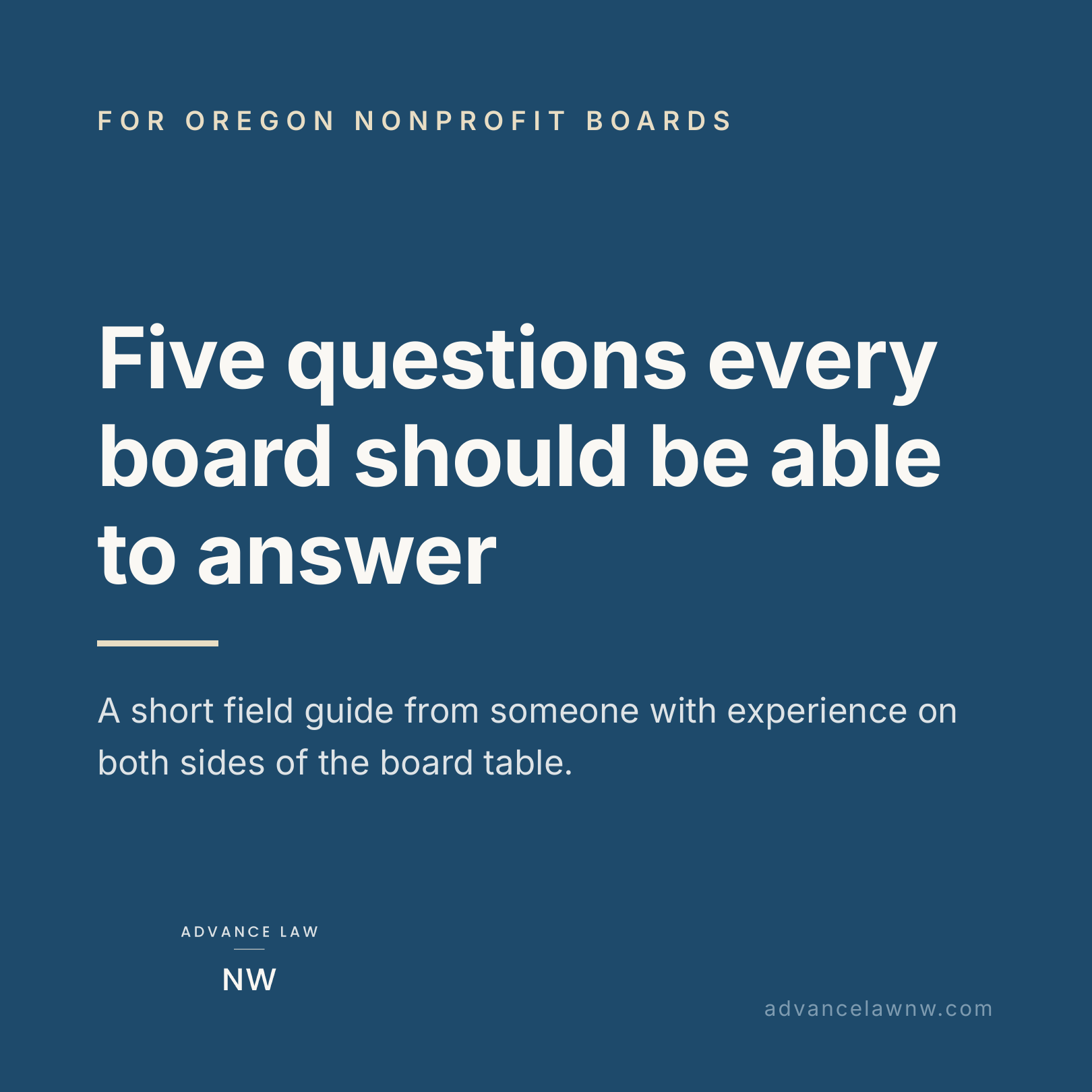
Five Questions every Board should be able to answer
Five Questions Every Board Should Be Able to Answer
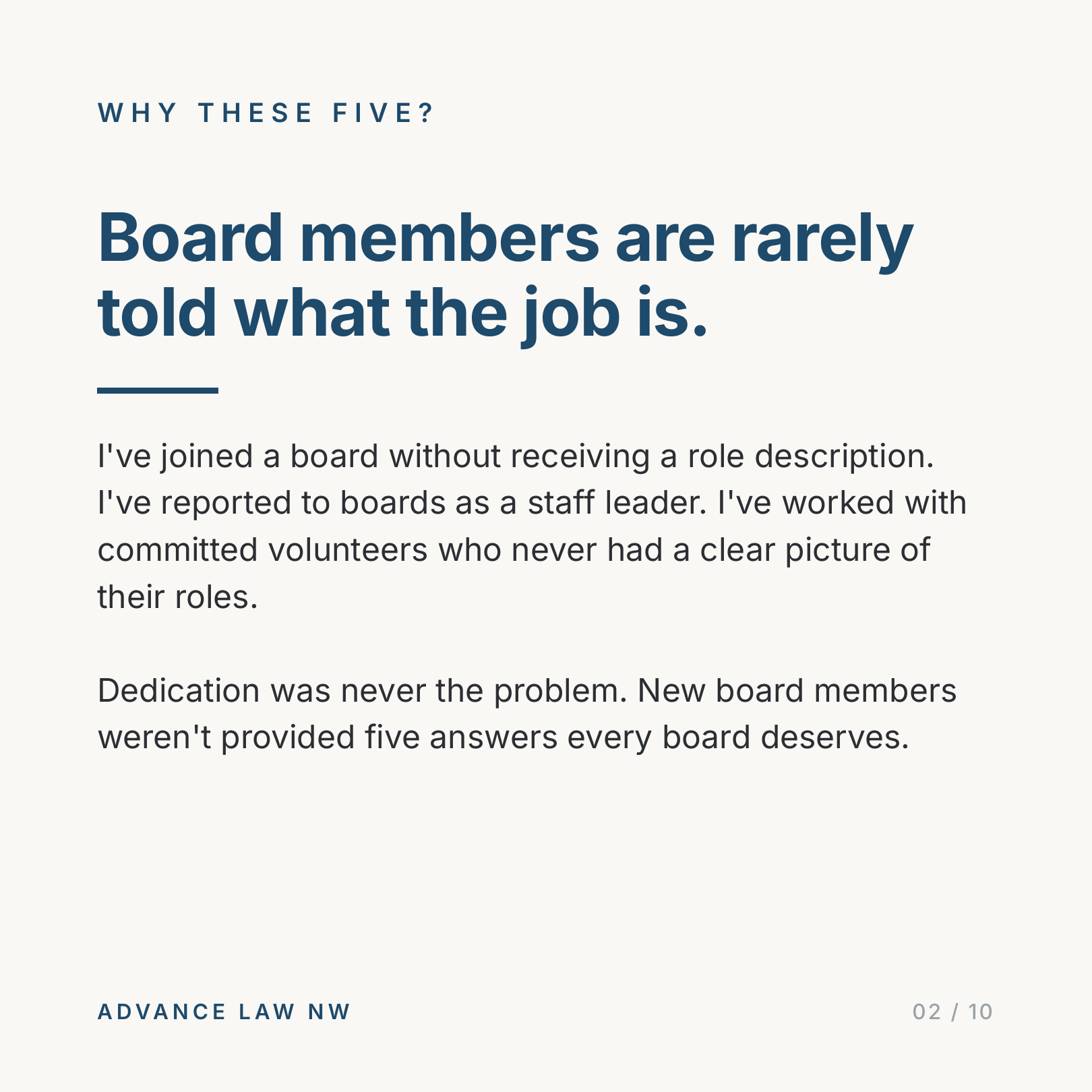
Board members are rarely told what the job is.
I know because I've lived it. I've joined a board without receiving a role description. I've reported to boards as a staff leader. I've worked with committed volunteers who never had a clear picture of their roles. Dedication was never the problem — new board members simply weren't provided the answers every board deserves.
After years of leading and working with mission-driven organizations, and serving on and reporting to their boards, I've found that strong governance comes down to five questions. Here they are, along with what your board can do about each one.
1. What do our bylaws actually say?
Not what everyone assumes they say; what they say.
Boards gradually drift from their bylaws — a skipped election here, an improvised vote there — until the documents and the practice diverge. It rarely happens through carelessness. It happens because volunteers are busy, institutional memory turns over, and nobody's job is to notice the gap.
The fix is simple and inexpensive: read the bylaws yearly, as a board, and update what no longer applies. An annual bylaws review takes one meeting and keeps your governing documents describing the organization you actually run. Learn about our bylaws review and updating services.
2. What is my role — legally?
Oregon law sets the standard. Under ORS 65.357, a director must act in good faith, with reasonable care, and in the best interest of the organization. Directors also owe a duty of obedience — carrying out the nonprofit's purposes — and a duty of loyalty, which means the organization's interests come before your own.
In plain terms: govern, don't manage. The board's job is to set direction, ensure the resources exist, and hold leadership accountable — and then let leadership lead the organization. Most board friction I've seen traces back to confusion on exactly this line.
3. How do new board members learn the role?
"You'll pick it up" is not onboarding.
A new director should receive the bylaws, recent minutes and financials, a role description, policies and procedures, and a real orientation — within their first month. None of that is complicated, but someone has to own it.
The difference shows quickly. Boards that onboard well get real contribution by month two. Boards that don't get a year of silence, then turnover that can impact organizational performance. Board training and member onboarding is one of our core services.
4. Are we acting like the employer we are?
If your nonprofit has employees, you have employment obligations — and your leaders deserve more than a handshake.
That means a current contract with a detailed job description. Clear expectations. An annual, documented review. Honest feedback in both directions. I spent years leading nonprofit organizations, and I can tell you what it feels like to work hard for a board that never put feedback in writing — and how much sustained performance depends on getting this right.
Most nonprofit employment issues start as governance issues that nobody documented.
5. When did a lawyer last review any of this?
For most small nonprofits the honest answer is: at incorporation, or during the last crisis.
Legal counsel works better as an annual rhythm than an emergency call — a yearly pass over bylaws, elections, onboarding, and contracts. The reasonable cost of compliance may help prevent the much higher costs of resolving just one dispute. Sustainable organizations build it into the calendar.
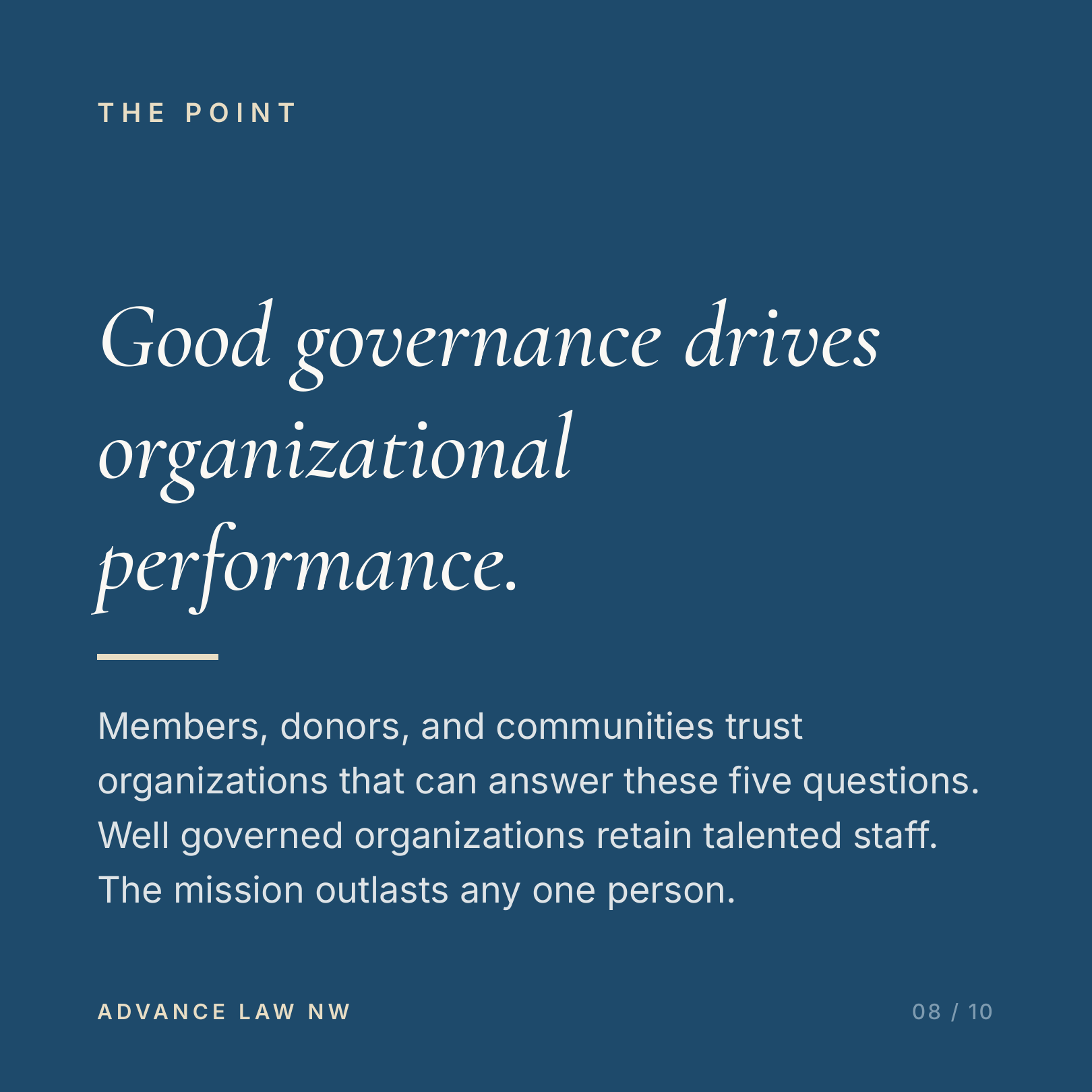
Good governance drives organizational performance
These five questions aren't paperwork for its own sake. Members, donors, and communities trust organizations that can answer them. Well governed organizations retain talented staff. The mission outlasts any one person.
About Advance Law NW
I'm Robin Bostwick. Before opening Advance Law NW, I led and worked with mission-driven organizations, and served on and reported to boards — through every governance lesson in this article and a few more. Advance Law NW is an Oregon practice offering accessible, year-round counsel to nonprofits and small businesses: bylaws, policies and procedures, board training, elections, employment, contracts, and compliance.
If your board can't yet answer all five questions, that's normal — and fixable. Tell us about your organization.
This article is general information, not legal advice. Reading it does not create an attorney–client relationship.